What does underlay do?
Top stitches pull on the fabric. Without a foundation they drag it inward, sink into soft or textured surfaces and leave ragged edges. Underlay fixes that before the visible stitching starts. It does three jobs:
- Stabilizes: it tacks the fabric to the stabilizer so the two move as one while the design sews.
- Supports: it lifts the top stitches so they sit on the surface instead of disappearing into the pile of a towel or fleece.
- Defines edges: a row of underlay just inside the outline gives satin borders and lettering a clean, straight edge.
Underlay is set per object, not per design. A small letter, a wide satin border and a large fill in the same logo each get different underlay.
What are the types of underlay?
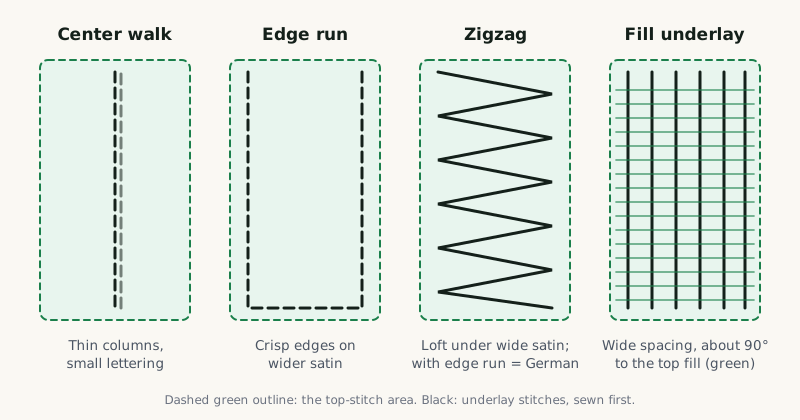
Names vary slightly between digitizing programs, but the same four types appear in almost all of them. The descriptions below follow the Ink/Stitch satin column documentation and fill stitch documentation.
| Type | How it sews | Typical use |
|---|---|---|
| Center walk (center run) | A running stitch down the middle of the column and back | Thin satin columns and small lettering, where there is no room for more |
| Edge run (contour) | A running stitch up one side of the column and back down the other, set in from the edge | Crisp edges on medium and wide satin columns |
| Zigzag | A low-density satin sewn along the column and back | Loft and support under wider satin, often combined with edge run |
| Fill (tatami) underlay | A light, widely spaced fill, usually at 90 degrees to the top fill | Large fill areas |
Edge run and zigzag together are often called German underlay, a common choice for wide satin borders on stable fabric.
Which underlay settings matter?
Choosing the type is half the job. The settings decide whether the underlay helps or shows through:
- Inset: how far inside the outline the underlay stops. Too little inset and underlay peeks out beside the top stitches; too much and the edge has nothing to support it. Ink/Stitch describes inset as the setting that makes the top layer cover the underlay entirely.
- Spacing: the distance between underlay rows. Fill underlay rows sit much further apart than the top fill; Ink/Stitch notes that underlay row spacing should be much wider than in the top stitching.
- Angle: fill underlay usually runs at 90 degrees to the top fill, so the two layers cross and hold each other flat.
- Layers: some fabrics need two passes of underlay at different angles, for example a first pass to flatten a pile and a second to support the top fill.
How much underlay the top stitches need also depends on the stitch density and the pull compensation set for the same object. They are tuned together.
How does the fabric change the underlay?
- Towels and terry: the loops swallow stitches, so the underlay first flattens the pile. A water-soluble topping helps too. See embroidery on towels.
- Fleece: similar to towels: firmer underlay so the design sits on top of the nap. See embroidery on fleece.
- Performance knits and thin polos: enough underlay to stabilize, but not so much that the design turns stiff or puckers the light fabric. See embroidery on performance fabric.
- Caps: underlay is sequenced from the center seam outward like the rest of the cap design. See our cap embroidery guide.
- Leather: every needle hole is permanent, so underlay is kept to what the design needs. See embroidery on leather.
What goes wrong with underlay?
| What you see | Likely underlay problem |
|---|---|
| Stitches sinking into fleece or towel | Too little underlay for the pile, or no topping |
| Wavy, uneven satin edges | No edge run under a wide column |
| Underlay visible beside the satin | Inset too small for the column |
| Stiff, board-like design | Heavy underlay stacked under a dense top fill |
| Fabric puckering around a fill | Underlay missing or too light; see why embroidery puckers |
Most of these are fixed in the file, not on the machine. If a design shows them on the right stabilizer and a firm hoop, the underlay needs changing.
Rather have it digitized for you?
Hand-digitized files from $10 per design, back in 4–8 hours, in every machine format.
Get a free quote →Frequently asked questions
Sources
- Ink/Stitch: satin column (underlay types and settings)
- Ink/Stitch: fill stitch (fill underlay, spacing, inset)
Sources checked 19 September 2026.