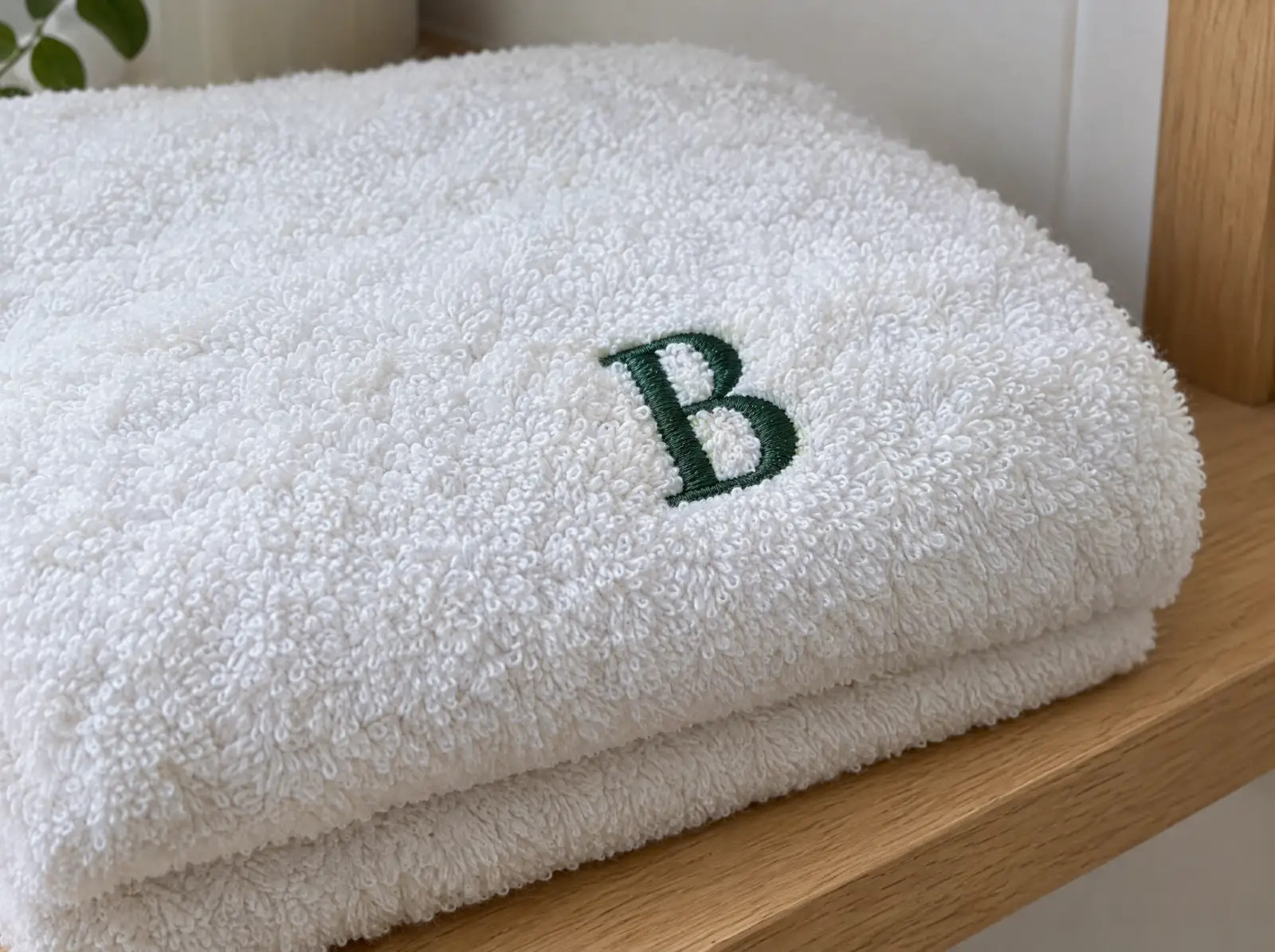
Why is embroidery on towels so hard?
Terry cloth is a woven base covered in raised loops. A design built for a flat shirt lays its stitches straight onto those loops. The thread pushes down between them, the edges look ragged and loops poke up through fills and letters.
Three things decide whether a towel design sits on top or disappears:
- The file: whether the pile is flattened before the visible stitches, and whether the shapes are wide enough to cover it.
- The topping: a film on top of the towel that stops the loops pushing through while the design sews.
- The design itself: Embroidery Library, a design publisher, advises choosing designs with solid fills for terry and avoiding light or delicate stitching, which gets lost in the loops.
The deeper and softer the pile, the more each of these matters. A thin kitchen towel forgives a lot; a thick bath sheet forgives almost nothing.
How is a design digitized for terry cloth?
Digitizing for towels starts under the design, not in it:
- Knockdown layer: a light, open stitch sewn first to press the loops flat where the design will sit. Wilcom calls its version the Laydown Stitch and describes it as a tool for high-nap fabrics such as terry toweling. It can follow the outline of the design with an offset, and sewn in a thread matched to the towel it sinks into the pile and stays almost invisible.
- Firmer underlay: once the pile is down, edge run and zigzag or fill underlay build a stable base, so the top stitches sit above the loops. See how embroidery underlay works for the types.
- Enough density to cover: the top layer has to hide the pile, so towel fills usually run fuller than the same fill on a polo. Too much, though, and a soft towel turns stiff. The balance is covered in stitch density.
- Wider satin columns: thin columns fall between the loops. Borders and letters are widened so they bridge the pile.
None of this can be added to a finished machine file. A DST or PES stores stitches, not objects, so a towel version of a logo is rebuilt from the working file.
Which topping and stabilizer should you use for towels?
Published guidance agrees on the topping and splits on the backing:
| Layer | What to use | Why |
|---|---|---|
| Topping | Water-soluble film on top of the towel | Melco says a water-soluble topper holds down any loft or nap on terry and fleece. It rinses away after sewing. |
| Backing | Soft tear-away or cut-away | Madeira recommends a soft tear-away for terry cloth towels and bathrobes, which keeps the reverse clean. Embroidery Library prefers cut-away in most cases, for support through repeated washing. |
| Needle | Sharp point | Madeira lists terrycloth with the heavy, tightly woven fabrics that call for a sharp needle. |
Soft tear-away suits thick towels where the back will be seen; cut-away suits thinner or looser terry and dense designs. Whatever the backing, hoop firmly without crushing the loops outside the design, which can leave a hoop mark that is hard to brush out. Terry weight varies a lot between suppliers, so sew one towel from each new batch before a full run.
How do you embroider names and monograms on towels?
Lettering is where embroidery on towels fails most often. Thin strokes vanish into the pile and the small counters inside letters such as a, e and o fill with loops. What works:
- Taller letters than the same text on a shirt, so each stroke is wide enough to cover the loops.
- Simple, bold fonts. Block and rounded sans serif letters hold up; hairline scripts and fine serifs do not.
- A knockdown panel behind the name for small text, so the letters sit on a flat patch rather than on the pile.
- Topping every time. Madeira notes its water-soluble topping keeps intricate parts of a design from sinking into the pile and improves crispness, especially with thinner 60 or 75 weight thread.
The limits for small text on flat fabric are covered in small lettering digitizing. On terry, plan for larger than those minimums.
What goes wrong with towel embroidery?
| What you see | Likely cause | Fix |
|---|---|---|
| Loops poking through fills | No knockdown layer, or no topping | Add topping; have the file rebuilt with a knockdown layer |
| Letters thin or unreadable | Text too small or columns too narrow for the pile | Enlarge the text and widen the satin columns |
| Ragged outline edges | Light underlay, or a running-stitch outline lost in the loops | Edge run underlay and a satin border instead of a run |
| Stiff, board-like patch | Heavy knockdown plus dense fill stacked on top | Lighter knockdown or reduced fill density |
| Crushed ring around the design | Hoop too tight on the pile | Hoop more gently, or float the towel on sticky backing |
Towel designs carry more stitches than the same logo on a shirt, because of the knockdown layer, firmer underlay and fuller fills. Our stitch count estimator has a towel and terry setting that shows the difference before you price a job. The same nap problem on another fabric is covered in embroidery on fleece, and every fabric is compared in the embroidery by fabric guide.
Do towels need a separate embroidery file?
Usually, yes. A logo digitized for polos or performance fabric uses light underlay and no knockdown, which is right for a thin knit and wrong for terry. If you sell the same logo on shirts and towels, keep two files built from the same artwork. Our towel embroidery digitizing service builds towel versions with the knockdown, underlay and lettering sizes planned for loop pile, hand digitized and checked by a second digitizer.
Rather have it digitized for you?
Hand-digitized files from $10 per design, back in 4–8 hours, in every machine format.
Get a free quote →Frequently asked questions
Sources
- Madeira USA: E-Zee Guide to choosing backings (terry cloth, topping)
- Madeira USA: Professor T.H. Read, choosing the correct needle
- Melco: selecting stabilizer and backing for embroidery
- Wilcom: the Laydown Stitch in EmbroideryStudio
- Embroidery Library: embroidering on terrycloth towels
Sources checked 19 September 2026.