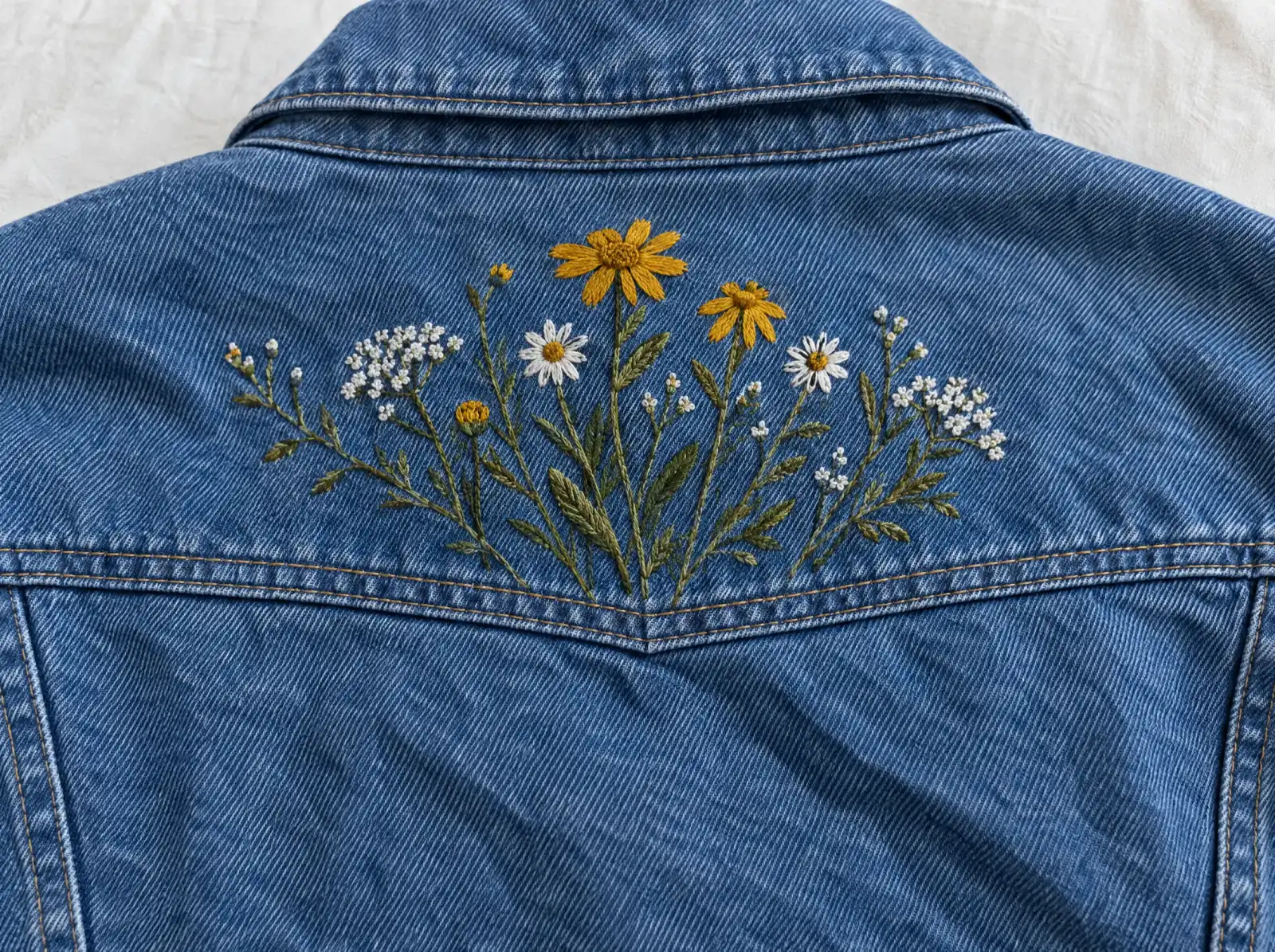
Why is denim good for embroidery?
Denim is a heavy twill: cotton yarns woven tightly on a diagonal. It hardly stretches and holds its shape under the pull of the stitches, so it puckers far less than a knit. Madeira groups denim with canvas and duck cloth, fabrics on which it says embroidered designs are practically limitless.
That stability has two consequences for a design:
- It can carry weight. Large, dense fills, full back jacket designs and appliqué all sew well on denim.
- Fine detail gets lost. The twill texture and color variation of denim break up thin lines. Sulky, a thread and stabilizer maker, advises choosing designs with plenty of fill stitching and steering clear of line-art style designs on denim.
How is a design digitized for denim?
| Setting | On denim | Compared with a knit polo |
|---|---|---|
| Density | Standard to full; the fabric supports it | A polo needs lighter density to avoid puckering |
| Underlay | Standard edge run and fill underlay | Similar, but denim needs no extra nap control |
| Pull compensation | Moderate; a stable woven draws in less | A stretchy knit needs more |
| Detail | Bold shapes, satin borders on fills | Finer detail is possible on smooth knits |
| Thread color | Contrast against the indigo, which varies wash to wash | Fabric color is usually uniform |
Density and compensation are tuned together; see stitch density and pull compensation. Heavy denim can take a design that would stiffen a shirt, but very dense fills still make a board-like patch on a lighter chambray or denim shirt, so match the file to the actual weight.
Which needle and stabilizer should you use on denim?
- Needle point: sharp. Madeira lists denim with the tightly woven and heavy fabrics that call for a sharp needle rather than a ballpoint. On commercial DB x K5 needles, Groz-Beckert describes its standard RG point as the one most suited to many embroidery fabrics.
- Needle size: match the needle to the thread and the weight of the denim. Sulky suggests a topstitch needle, 80/12 for 40 weight thread and 90/14 for 30 weight, on home machines. A needle that is too thin for heavy denim deflects, which Groz-Beckert lists as a cause of irregular embroidery on woven fabric.
- Backing: tear-away. Madeira recommends tear-away for tightly woven fabrics such as heavy twill and denim, heavier for large, dense designs and lighter for small, open ones. The fabric supports the design through the life of the garment, so the backing only has to hold it during sewing.
- Topping: usually none. Denim has no nap to hold down.
A light cut-away is still worth considering on stretch denim with elastane, which behaves more like a knit.
How do you embroider jeans and denim jackets around seams?
Flat denim yardage is easy. Finished garments are not. Sulky notes that in most cases readymade denim is not hoopable in the usual way, because of thick seams and rivets. Common approaches:
- Keep the design off seams. A felled seam is several layers of heavy denim. Sewing across it deflects the needle, breaks thread and throws the design out of register. Plan the size and position so the design sits between seams.
- Hoop the backing, not the garment. Sulky suggests hooping a sticky stabilizer alone and pressing the garment onto it, or using a magnetic hoop that clamps thick layers without forcing them into a ring.
- Open a seam when you must. Jeans legs often need a side seam opened to reach the embroidery area; the seam is closed again afterward.
- Embroider before construction if you make the garments, or sew a patch and apply it.
Keep the hoop, the presser foot and the needle path clear of rivets, metal buttons and zips. A needle striking metal breaks, and can damage the needle plate or hook. Clip jump threads on both sides as you go, so loose loops do not catch inside a leg or sleeve.
Jacket backs are the easiest denim placement: a large flat panel between the yoke and hem seams. Before running a heavy back design, open the file in our DST file viewer to confirm its size fits between the seams.
How does denim compare with other heavy fabrics?
Denim sits at the stable end of the range. Embroidery on leather is also heavy but needs the opposite approach, with lower density because every hole is permanent. Twill caps are close to denim in fabric but have their own sequencing problems, covered in our cap embroidery guide. Every fabric is compared side by side in the embroidery by fabric guide.
For workwear programs that put one logo on denim, canvas and polos, our workwear and uniform digitizing builds a version per fabric from the same artwork, hand digitized and checked by a second digitizer.
Rather have it digitized for you?
Hand-digitized files from $10 per design, back in 4–8 hours, in every machine format.
Get a free quote →Frequently asked questions
Sources
- Madeira USA: E-Zee Guide to choosing backings (denim, heavy twill)
- Madeira USA: Professor T.H. Read, choosing the correct needle
- Sulky: denim embroidery tips
- Groz-Beckert: machine needles for single and multihead embroidery
Sources checked 19 September 2026.