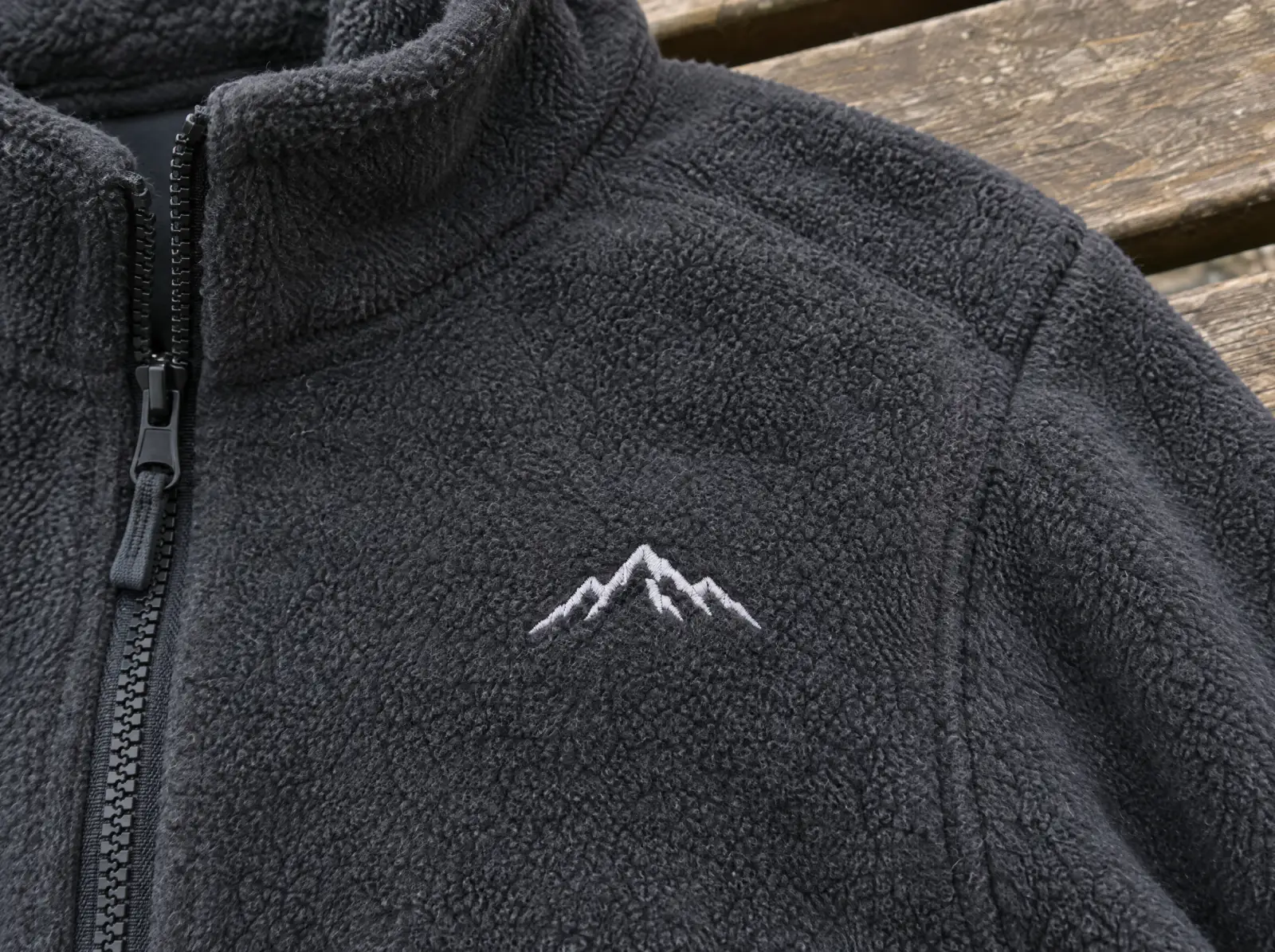
Why is embroidery on fleece tricky?
Fleece is a knit with a brushed, fuzzy surface. Two things work against a design at once:
- The nap. The raised fibers swallow thin stitches. Small lettering and running-stitch details disappear and fibers poke up through fills.
- The knit. Underneath the nap, fleece stretches. A design pulls it in, so fills can pucker and outlines drift away from the shapes they surround.
Thick fleece is also lofty. A hoop clamped hard on it crushes the pile into a ring around the design, and the finished garment is soft enough that a heavy, dense logo sits on it like a stiff board. Good fleece embroidery balances all three: hold the nap down, support the knit, keep the design flexible.
Not all fleece is the same. Polar fleece is napped on the face and moves the most. Sweatshirt fleece is usually smooth on the outside and brushed inside, so it embroiders more like a heavy jersey. Sherpa and plush blanket fleece have the deepest pile and behave more like towels. Check which side the design will sit on before choosing the underlay and topping.
How should a design be digitized for fleece?
- Underlay that flattens first. A fill underlay or edge run and zigzag under satin presses the nap down and gives the top stitches a surface. On deep pile, a first underlay pass to flatten and a second to support is common. See underlay types and settings.
- A knockdown layer on deep pile. On sherpa, plush and heavy blanket fleece, a light, open knockdown stitch under the design flattens a larger area, the same approach used for embroidery on towels. Wilcom describes its Laydown Stitch as a tool for high-nap fabrics including knits.
- Density to cover, not to armor. Fills need enough coverage to hide the nap, but every extra row adds stiffness. Well-built underlay lets the top density stay moderate. See stitch density.
- Pull compensation for a knit. Fleece stretches, so shapes need more compensation than on a woven jacket to keep fills meeting their outlines.
- Bolder lettering. Thin serifs and small counters fill with fibers. Taller letters and wider satin columns stay readable.
What stabilizer, topping and needle work on fleece?
| Item | Recommendation | Source |
|---|---|---|
| Backing | One or two pieces of a lightweight, no-show cut-away | Madeira backing guide |
| Topping | Water-soluble film on top to hold down the nap | Madeira and Melco |
| Needle | Ballpoint, which pushes knit fibers aside rather than cutting them | Madeira needle guide; Groz-Beckert recommends ball points for knits |
A cut-away backing stays in the garment and supports the design through washing, which a stretchy knit needs. A lightweight no-show version keeps the back soft against the skin. Madeira notes its water-soluble topping is used on fleece, sweaters, corduroy and terry to keep details from sinking into the pile, and dissolves with water or steam after sewing.
When hooping, hoop firm and flat without stretching the fleece, and avoid crushing the pile outside the design. Thick fleece blankets and jackets are often easier to float: hoop the backing alone and fix the fleece on top with adhesive backing or temporary spray, which Madeira says should be applied to the backing, never the garment.
What goes wrong with embroidery on fleece?
| What you see | Likely cause | Fix |
|---|---|---|
| Fibers poking through fills | No topping; underlay too light | Add topping; firmer underlay in the file |
| Lettering lost in the nap | Text too small, thin strokes, no topping | Larger, bolder letters and topping |
| Gaps between fills and outlines | Fleece stretching; too little pull compensation | Cut-away backing; more compensation in the file |
| Stiff, board-like logo | Dense fill over heavy underlay | Lower top density, keep the underlay |
| Crushed ring around the design | Hoop clamped too hard on the pile | Hoop more gently or float the fleece |
Puckering on fleece follows the same rules as on other knits; the full diagnosis is in why embroidery puckers.
Can one logo file work on fleece and shirts?
It can sew, but it rarely looks its best on both. A polo or performance fabric file uses light underlay to stay soft on a thin knit; fleece needs firmer underlay and bolder lettering to sit above the nap. Uniform programs that run the same logo on polos, softshells and fleece usually keep a version per fabric, built from the same artwork so sizes and colors match. Our workwear and uniform digitizing builds those versions, hand digitized and checked by a second digitizer.
Firmer underlay adds stitches, so a fleece version sews a little longer than the shirt version. Enter its stitch count in the embroidery run time calculator to plan a run. The other fabrics are compared in the embroidery by fabric guide.
Rather have it digitized for you?
Hand-digitized files from $10 per design, back in 4–8 hours, in every machine format.
Get a free quote →Frequently asked questions
Sources
- Madeira USA: E-Zee Guide to choosing backings (fleece, topping)
- Madeira USA: Professor T.H. Read, choosing the correct needle
- Melco: selecting stabilizer and backing for embroidery
- Groz-Beckert: machine needles for single and multihead embroidery
- Wilcom: the Laydown Stitch in EmbroideryStudio
Sources checked 19 September 2026.