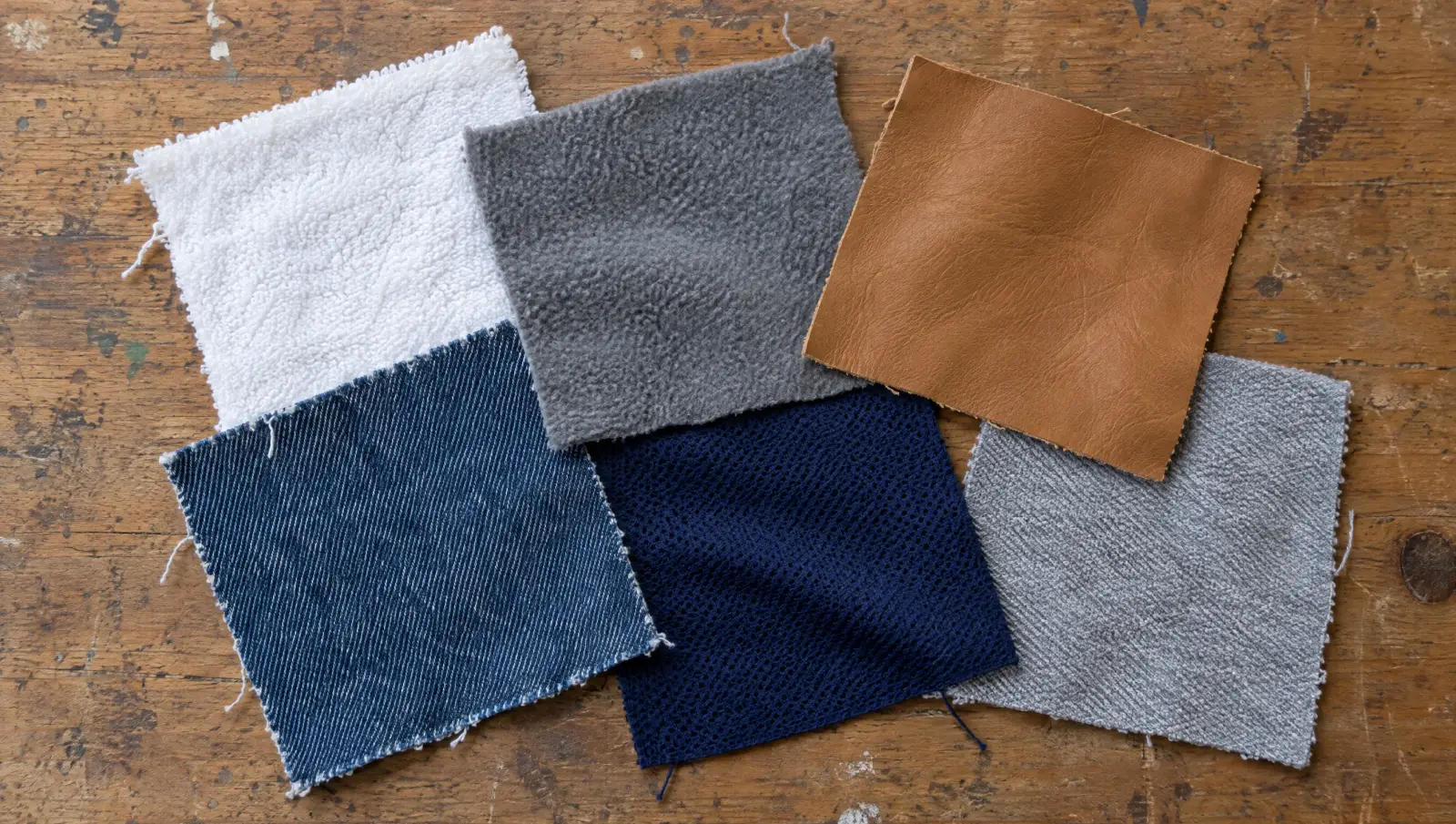
Why does the fabric change how a design is digitized?
Every stitch pulls on the fabric under it. How a fabric responds to that pull decides almost everything about the file:
- Stretch: knits draw in and pucker, so they get lighter density, more pull compensation and a backing that stays in the garment.
- Surface: loops and nap swallow thin stitches, so towels and fleece get underlay or a knockdown layer that flattens the pile first.
- Weight and weave: heavy, tight wovens hold their shape, so they carry dense fills with a temporary backing.
- Whether holes heal: woven and knit fibers close around the needle; leather and vinyl do not, so density comes right down.
Madeira, the thread and backing maker, sums up the setup side in two rules: the fabric construction decides the type of backing, and the design decides its weight. The digitizing side follows the same logic, which is why one logo often needs a version per fabric.
What stabilizer, topping and digitizing does each fabric need?
| Fabric | Backing | Topping | Needle | Main digitizing change |
|---|---|---|---|---|
| Towels and terry | Soft tear-away or cut-away | Water-soluble, always | Sharp | Knockdown layer, firm underlay, wider satin and larger text |
| Fleece | Lightweight no-show cut-away, one or two layers | Water-soluble | Ballpoint | Firm underlay, moderate density, bolder lettering |
| Leather and faux leather | Tear-away, clamping or magnetic frame | None | Round point (RG or R), not a cutting point | Lower density, light underlay, open designs |
| Denim and twill | Tear-away, weight matched to the design | Usually none | Sharp | Full density, bold fills, placement clear of seams |
| Performance knits | Thin cut-away made for performance wear | Only on textured pique | Fine ballpoint | Lighter density, more underlay and compensation, smaller designs |
Backing and topping follow the Madeira backing guide; needle points follow Madeira and Groz-Beckert. Always test on a spare piece of the actual garment, because weights vary between suppliers.
What about caps and hi-vis?
Both have their own pages. Caps are stiff twill on a curved frame, so the main problem is distortion and sequencing rather than the fabric; see our cap embroidery guide. Hi-vis garments are thin fluorescent polyester with reflective tape to keep clear of; see hi-vis embroidery digitizing.
How do you test embroidery on a new fabric?
- Identify the construction. Knit, woven, napped or non-woven decides the backing type before anything else.
- Match the file to the fabric. Ask whether the design was digitized for this fabric, or for something heavier or lighter.
- Sew a sample on the real garment, or an offcut of the same material, with the backing, topping and needle you plan to use.
- Check it after unhooping and after a wash. Puckering, gaps and sinking often show only once the fabric relaxes.
- Change one thing at a time. If the setup is right and the fault repeats, the file needs changing.
Can one embroidery file work on every fabric?
A file will sew on any fabric, but it is built for one. A polo file is too light for a towel and too dense for a performance tee; a denim file would perforate leather. Machine files such as DST store stitches, not objects, so density and underlay cannot be changed properly after export. The fabric version has to be rebuilt from the working file.
For shops that put one logo on several garments, the practical answer is a set of versions from the same artwork, so size and colors match. Our embroidery digitizing service builds fabric-specific files, hand digitized and checked by a second digitizer, and our towel digitizing service covers terry. When a design already puckers or sinks, our guide to why embroidery puckers helps decide whether the file or the setup is at fault, and the stitch count estimator shows how the count changes by fabric.
Frequently asked questions
Sources
- Madeira USA: E-Zee Guide to choosing backings
- Madeira USA: Professor T.H. Read, choosing the correct needle
- Groz-Beckert: machine needles for single and multihead embroidery
- Melco: selecting stabilizer and backing for embroidery
Sources checked 19 September 2026.