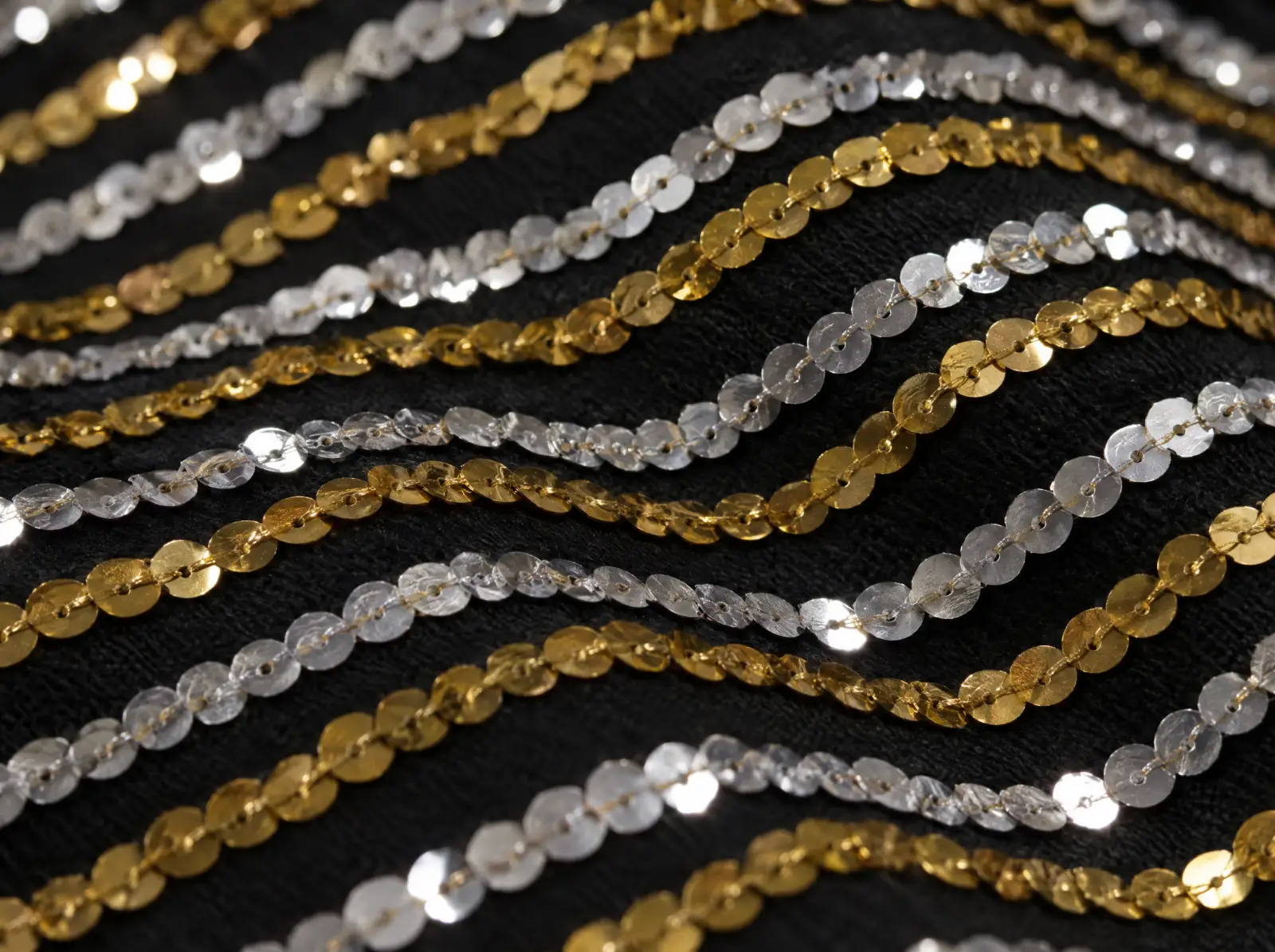
How does a sequin device drop and stitch each sequin?
Sequins for machines come as a continuous strip on a reel, not loose. A sequin feeder patent assigned to Tokai Kogyo (Tokai Industrial Sewing Machine), which manufactures Tajima machines, describes the cycle each sequin goes through:
- Feed. The strip is drawn from the reel onto a supporting plate under the needle. A feed lever hooks into the center hole of a sequin and advances the strip by one sequin pitch.
- Hold. A lock lever engages the next sequin's center hole, so the strip is held at two points and cannot shift.
- Needle. The needle passes through the center hole of the front sequin, placing it on the fabric.
- Cut. A movable blade cuts the connecting portion between that sequin and the rest of the strip.
- Fix. Running stitches over the sequin, which Wilcom calls fixing stitches, hold it down before the next drop.
The cycle repeats for every sequin in the design, so the spacing between drops decides both how the sequins overlap and how many a shape uses. Where each sequin lands, and which stitches fix it, is set in the design file as a sequin drop. That is covered in sequin embroidery files.
What is the difference between single and twin sequin devices?
A single device holds one sequin type. A twin device holds two and switches between them during the design, so two sizes or colors can be sewn without stopping. Makers publish these configurations:
| Device | Type | Sequin size | Notes from the maker |
|---|---|---|---|
| Tajima Sequin Device III Twin | Twin | 3 to 9 mm | Switches type by sliding the supply unit left or right; up to 4 sequin types per head (two each side) |
| Tajima Sequin Device IV | Large-sequin device | 2 to 22 mm | Also takes noncircular and eccentric sequins; feed amount set on the operation panel |
| ZSK T7 | Twin | 2 to 9 mm | Two twin devices on one head give up to 4 sequins |
| ZSK V6.1 | Single | 3 to 9 mm | Stepper motor driven, no air connection |
| ZSK V9 | Single | 3 to 19 mm | For larger sequins |
Devices mount on the side of the head. ZSK fits them on the left and right of the head, with a third in the center on 18-needle heads. Both Tajima and ZSK give a maximum of 1,000 rpm for sequin embroidery, and Tajima gives 800 rpm when switching between twin sequin types.
What sequin sizes can a machine sew?
The range depends on the device, as the table shows: roughly 3 to 9 mm on standard single and twin devices, and up to 19 or 22 mm on large-sequin devices. Within that range, three things follow from the size you load:
- Spacing. The distance between drops is set from the sequin diameter. Wilcom's help tells digitizers to set a fixed run length that matches the sequin type, so sequins overlap evenly instead of standing up or leaving gaps.
- Feed. The device advances the strip by one sequin pitch, so it is set for the size on the reel. On the Tajima Sequin Device IV the feed amount is changed on the operation panel.
- Shape. Besides round sequins, some devices, such as the Tajima Sequin Device IV, also take noncircular and eccentric shapes.
So a sequin design is built for a size. Running it with a different size loaded changes the overlap, which is why your digitizer asks which sequin is on the machine. Give the diameter in millimeters and, for a twin device, which size or color sits in which position, because that mapping is written into the file.
What does a machine need to sew sequins?
- A sequin device fitted to the head. A machine without one cannot place sequins. Tajima lists which of its models each device fits, so check the device against your model.
- The right reels loaded. The file expects a particular sequin in each slot, left or right, and on twin devices in each position.
- A file in a sequin-capable format. If the machine format chosen in the digitizing software has no sequin capability, a sequin object is saved as fixing stitches with no sequin drops. Which formats carry the commands is covered in sequin embroidery files, and machine formats in general in embroidery machines and formats.
Sequin work is often mixed with ordinary stitching: sequins for bold fills, thread for outlines and small text. Before a run, the free DST file viewer shows the stitch paths so you can see how the design moves. For a file built for your device and sequin size, see our sequin embroidery digitizing service. Sequins sit alongside chenille and Coloreel in our specialty embroidery guides.
Rather have it digitized for you?
Hand-digitized files from $10 per design, back in 4–8 hours, in every machine format.
Get a free quote →Frequently asked questions
Sources
- Tajima Europe: Sequin Device III Twin type
- Tajima Europe: Sequin Device IV
- ZSK: sequin devices for embroidery machines
- Tokai Kogyo patent US7082884: sequin feeder
- Wilcom EmbroideryStudio help: insert manual sequin drops
Sources checked 19 September 2026.